Kwan Woo Kim

Horizontal Stratification Amid Educational Expansion

I study the consequences of the rise of online degree programs in higher education, and of the parallel expansion of graduate education — two fronts on which the meaning of a college credential is fracturing into unevenly rewarded pathways.

Online Degree Modality

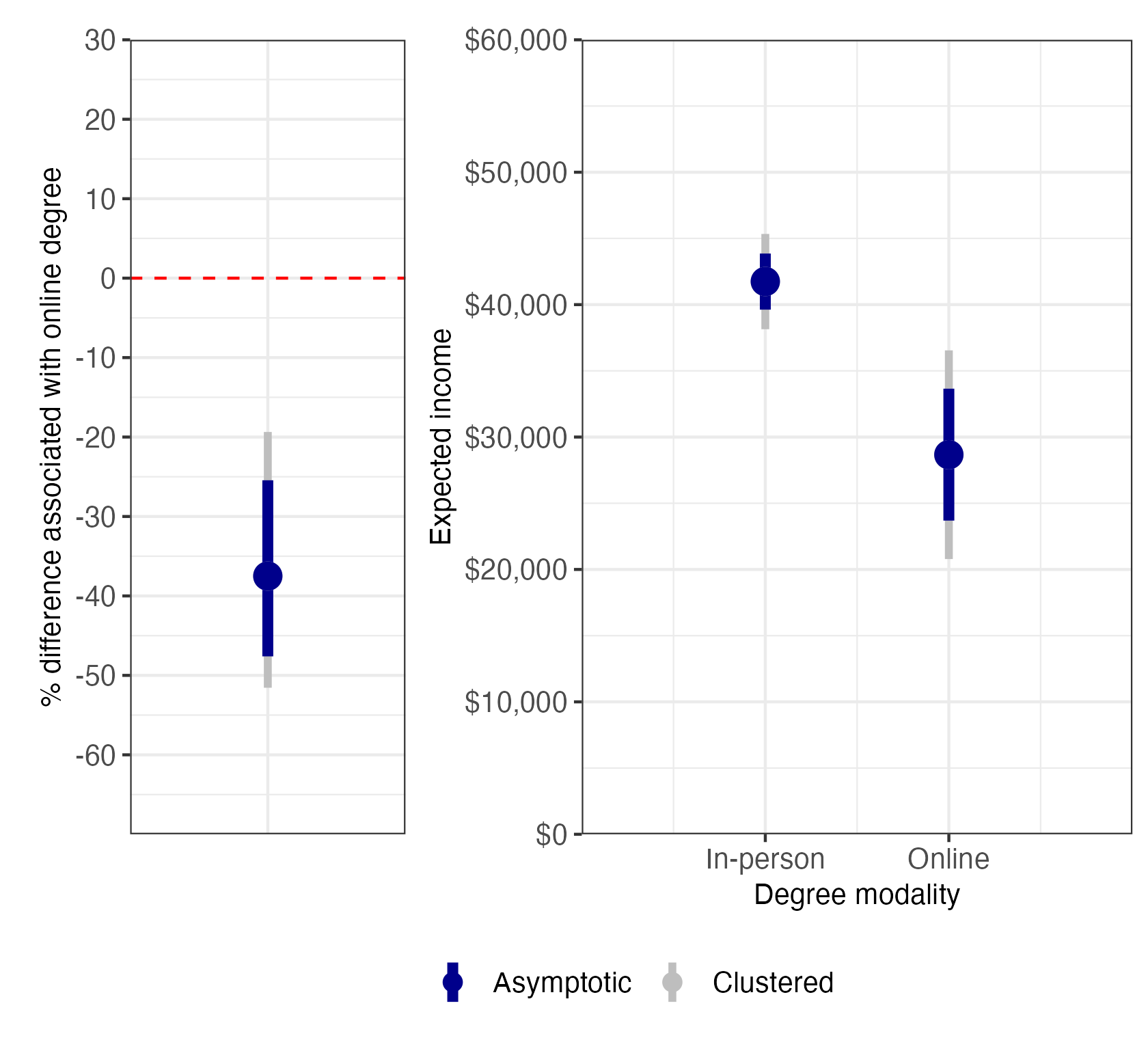
Percent difference in income associated with an online degree, and expected income by degree modality

Kim, Kwan Woo and Laura Hamilton. “Online Education and Future Financial Well-Being: Do College Social Interactions Matter?” Revise and Resubmit, Sociology of Education.

We theorize degree modality as an increasingly consequential form of horizontal stratification: online and in-person programs organize distinct pathways to the academic, social, and career-building interactions through which students acquire skills and signal their value to employers. Using the nationally representative Baccalaureate and Beyond (B&B) survey, we compare the income trajectories of students who earned their degrees exclusively online versus in-person, matching on socioeconomic background, pre-college academic record, and college major. Three years after graduation, exclusively online degree holders earn approximately 39 percent less than otherwise similar in-person graduates — a gap that holds even among graduates of the same college, and that is partially explained by unequal participation in extracurricular clubs, senior capstones, and paid internships. The findings suggest that expanding access to college through online education is not sufficient on its own: colleges need to ensure that online students have equitable access to the activities and career development programs that narrow modality-based earnings gaps.
Graduate Education Expansion

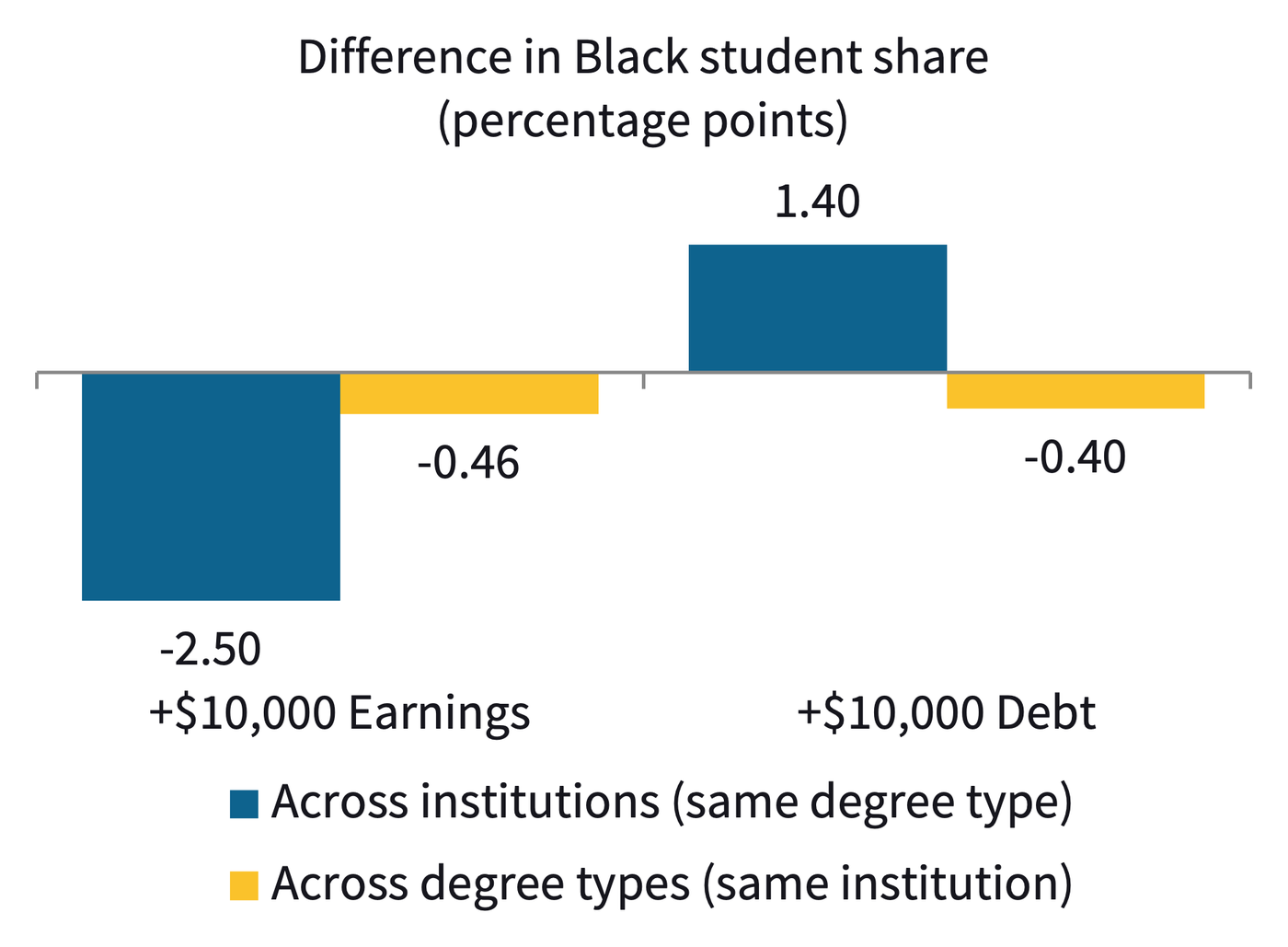
Bar chart of the difference in Black student share, in percentage points, associated with $10,000 more program earnings and $10,000 more program debt, decomposed into across-institution and across-degree-type components

Kim, Kwan Woo, Adam Goldstein, and Charlie Eaton. “Organizations and Effectively Maintained Inequality in U.S. Graduate Education: Racial Sorting by Graduate Degree Program Quality Measures.” Working Paper.

About one-third of working-age college graduates pursue graduate education at some point, and its economic premiums are not evenly distributed. We extend the theory of effectively maintained inequality (EMI) to disparities among graduate degree holders, arguing that as graduate education expands, horizontal stratification among graduate degree holders intensifies. Drawing on the Survey of Consumer Finances, we find highly racialized patterns of return: compared to white households with graduate degrees, who hold more net worth and earn more than their college-educated counterparts, Black households with graduate degrees earn smaller income premiums, carry substantially more debt, and hold less net worth than Black college graduates. Analysis of College Scorecard data shows that Black students are concentrated in graduate programs that yield higher debt and lower earnings, and that this racial sorting has intensified over time — evidence that graduate education is a new domain of education-based horizontal stratification.

Future Projects: Exposure to Generative AI and College Major Choices

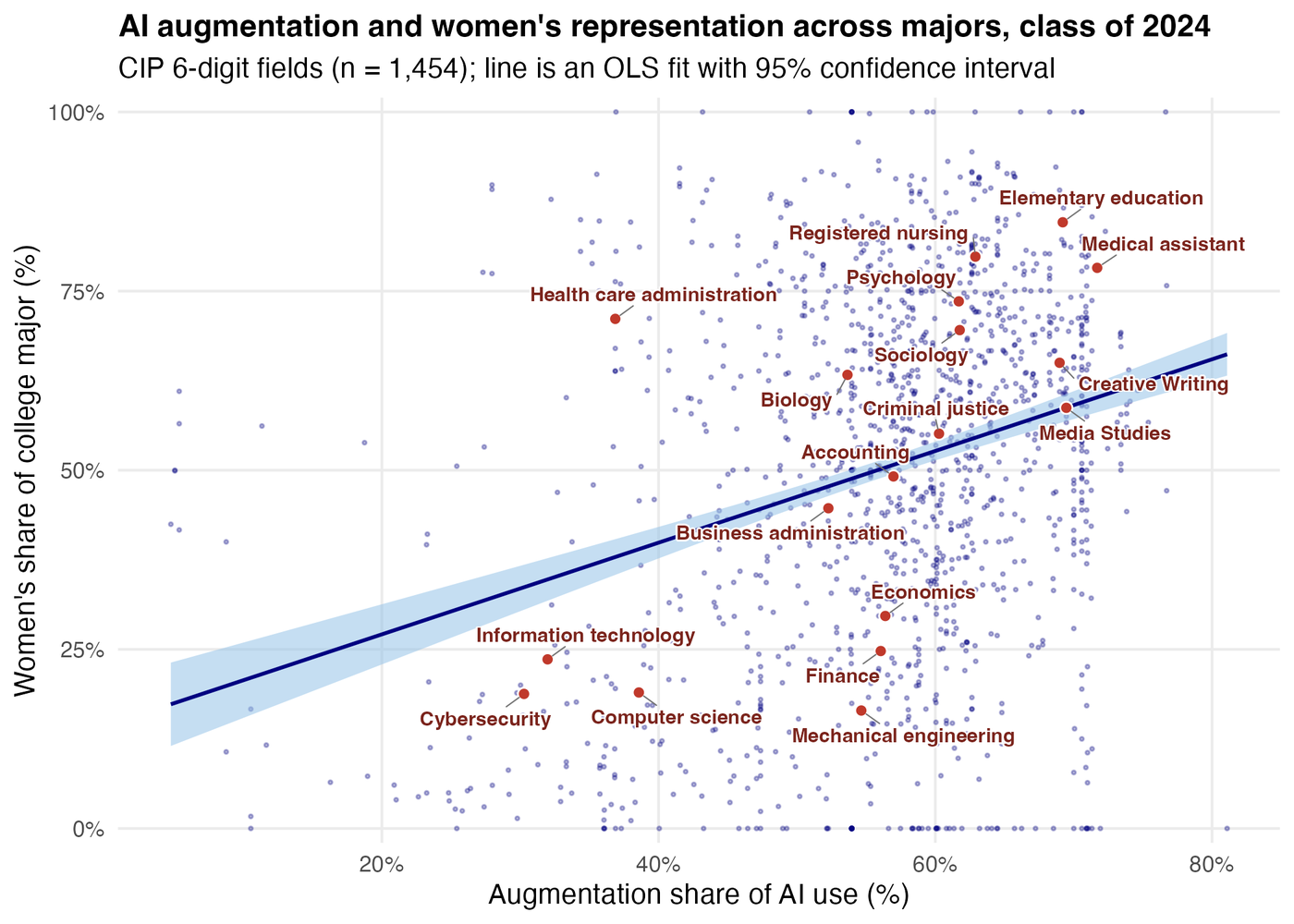
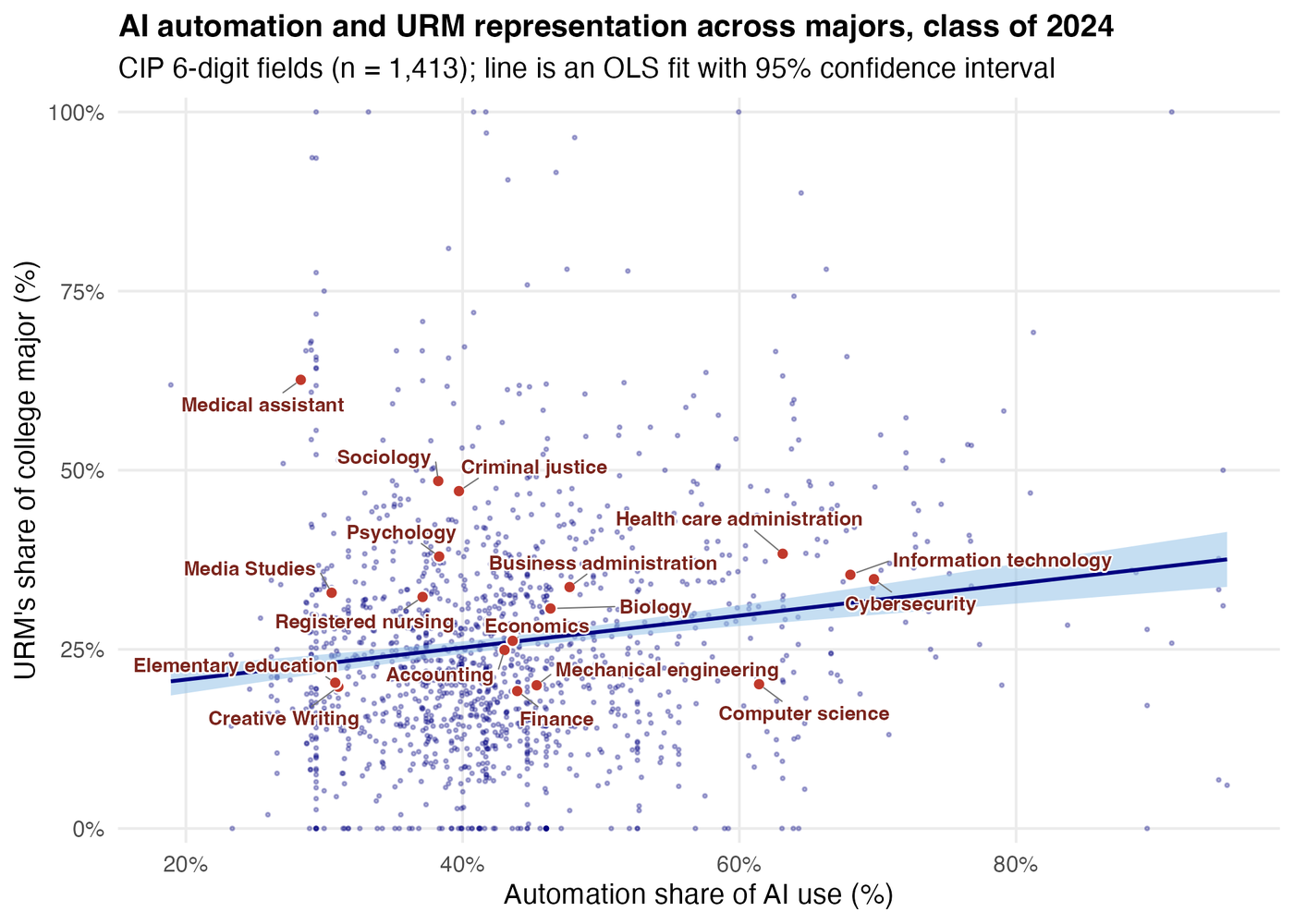
Scatterplot of AI automation share against underrepresented minority share of college major, CIP 6-digit fields, class of 2024, showing a positive OLS fit Scatterplot of AI augmentation share against women's share of college major, CIP 6-digit fields, class of 2024, showing a positive OLS fit

My work on online degrees and graduate education shows that returns to education are increasingly stratified by which pathway students take, and artificial intelligence is poised to redraw the hierarchy of those pathways. As large language models change how people work within occupations, they change the relative value of college majors. Linking fourteen years of college completion data to occupation-level measures of AI use, my preliminary analysis finds that fields where AI is used to automate human tasks enroll a significantly higher share of students from underrepresented minority backgrounds, while fields where AI is used to augment human tasks enroll higher shares of women — net of overall AI exposure, which shows no association with major demographics. Extending EMI theory, I predict that students with the most educated, STEM-proximate, and well-connected parents will be the first to move out of newly devalued college majors, and I plan to track how existing racial and gender disparities in AI exposure evolve over time.

Preliminary analysis, class of 2024. Occupation-level automation and augmentation shares are matched to 6-digit CIP fields; each point is a field of study.