Kwan Woo Kim

Organizational Inequality in Higher Education

My primary line of research asks why the demographic change in the academic workforce has lagged behind the growing diversity of the Ph.D. pipeline. In my dissertation, Institutional Barriers to the Diversification of the Academic Workforce, I argue that organizational uncertainty slows this process: when a university relies heavily on a single revenue stream, faces an economic recession, or sees a decline in performance metrics, it reinforces organizational structures and practices that disadvantage historically marginalized groups, or that advantage only certain demographic groups.

Faculty Diversification & Resource Dependence

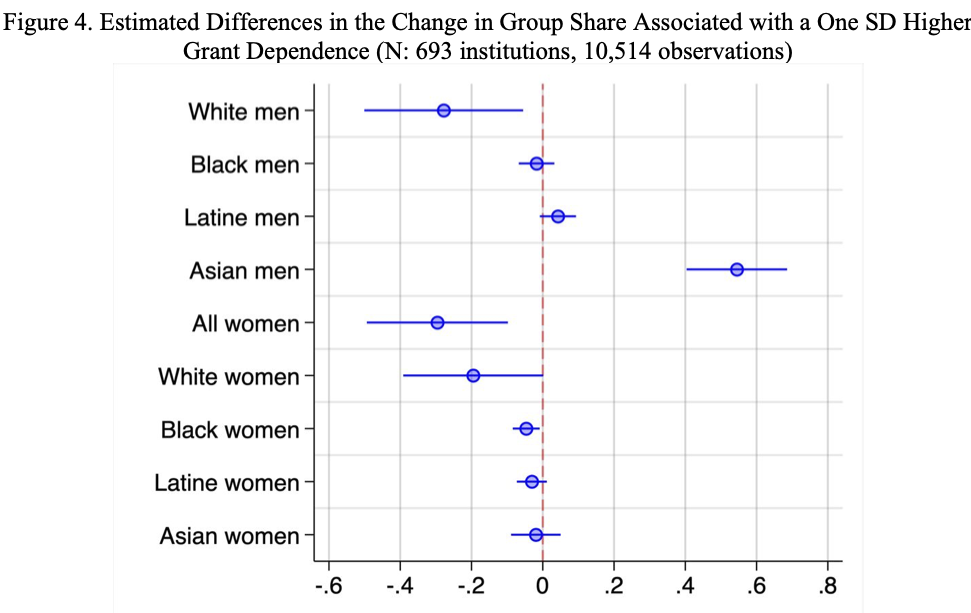
Coefficient plot of estimated differences in the change in faculty group share associated with one standard deviation higher grant dependence, by demographic group: Asian men gain while white men and white women lose ground

Kim, Kwan Woo. “Selective Inclusion: Resource Dependence and the Uneven Diversification of the U.S. Professoriate, 1993–2019.” Under Review.

Reframes the question from whether universities diversify to which marginalized groups gain ground during diversification, and why. I theorize that as the academic labor pool diversifies, universities channel employment toward the subunits and demographic groups perceived as most capable of securing core resources — a pattern I call selective inclusion. Using population data on American colleges and universities, I find that institutions more dependent on research grants saw disproportionate growth among Asian men, while those dependent on tuition saw disproportionate growth among white women; Black and Latine scholars did not see comparable gains across either environment. Differences in how faculty positions are distributed across fields explain part of this divergence, but most of it reflects changes in faculty composition within fields.
Hiring Amid Economic & Political Shocks

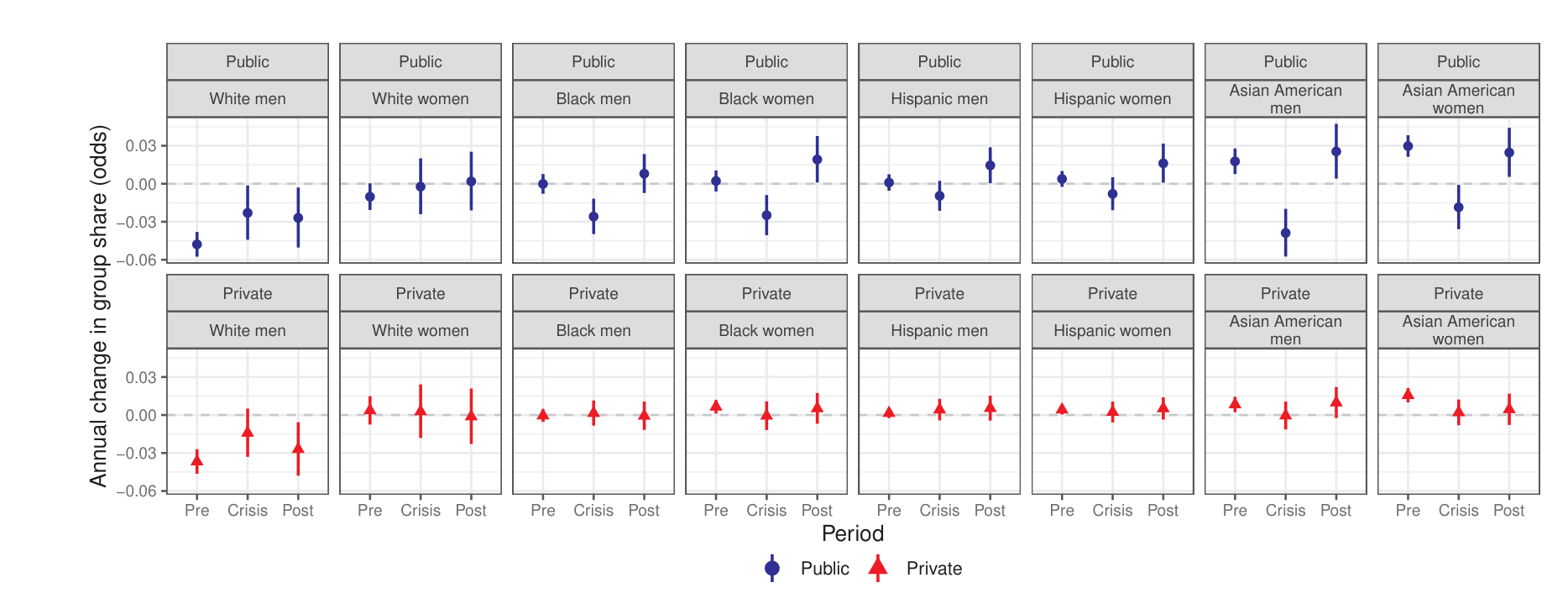
Predicted annual change in the share of each demographic group among tenure-track hires before, during, and after the Great Recession, in public and private institutions

Kim, Kwan Woo, Alexandra Kalev, Frank Dobbin, and Gal Deutsch. 2021. “Crisis and Uncertainty: Did the Great Recession Reduce the Diversity of New Faculty?Sociological Science 8:308–24.

Shows that the Great Recession disproportionately reduced the share of Black, Latine, and Asian faculty hires, especially at public and research universities that faced severe budget cuts and endowment losses.

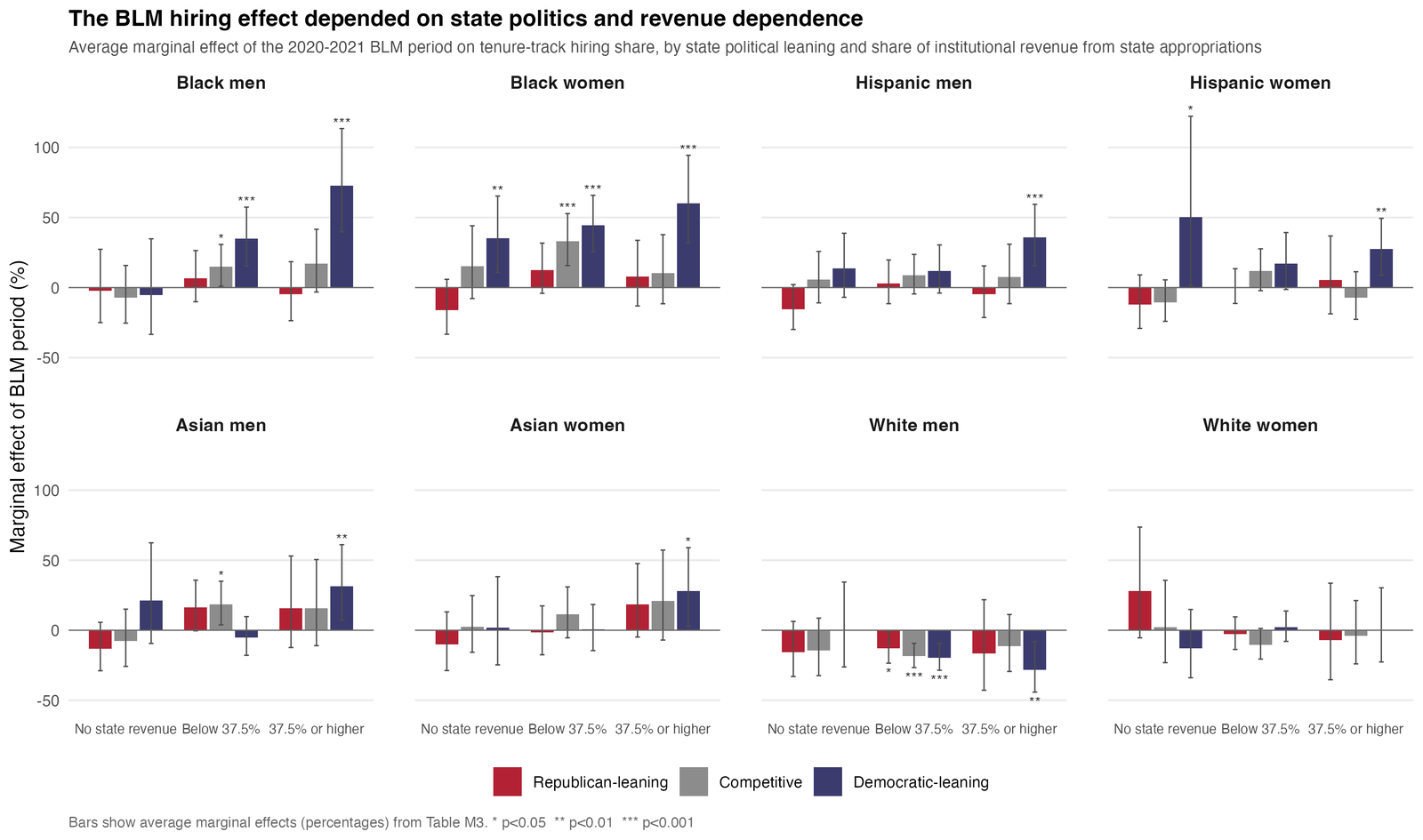
Average marginal effect of the 2020-2021 Black Lives Matter period on tenure-track hiring share, by demographic group, state political leaning, and share of institutional revenue from state appropriations

Kim, Kwan Woo, John Towey, Alexandra Kalev, Frank Dobbin, and Gal Deutsch. “Social Movements Can Have (Fleeting) Effects on Faculty Diversity.” Working Paper.

Finds that the increase in Black faculty hires during the 2020 Black Lives Matter movement was short-lived and concentrated in Democratic-leaning states. Gains for Black and Hispanic faculty were largest at institutions in Democratic-leaning states that drew a substantial share of revenue from state appropriations, while white men’s share declined in those same settings.

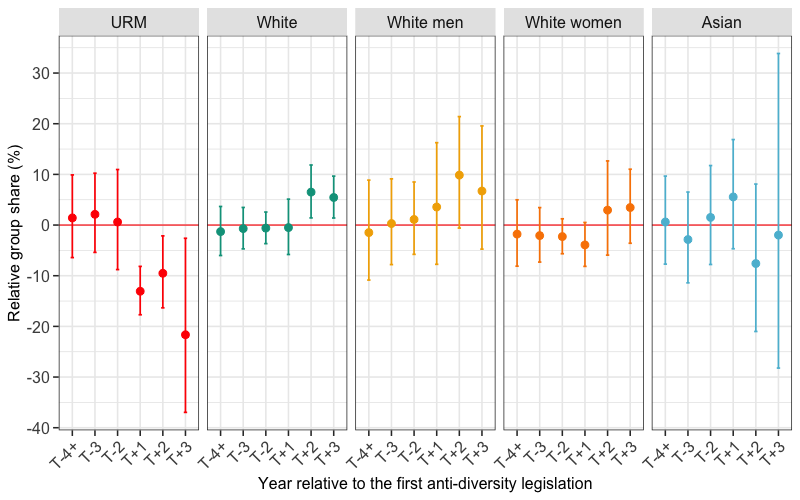
Event-study plot of relative group share by year relative to the first anti-diversity legislation, for underrepresented minority, white, white men, white women, and Asian faculty

Kim, Kwan Woo and Laura Hamilton. “Acting Before the Law: How Anti-Diversity Legislation Reshapes Faculty Hiring Before It Passes.” Working Paper.

Shows that anti-diversity bills introduced in state legislatures were followed by a substantial decline in Black and Latine faculty hires at public colleges and universities — even before those bills became law. Reliance on state appropriations makes institutions more responsive to their political environment, consistent with resource dependence theory.

Work-Life Policy Design

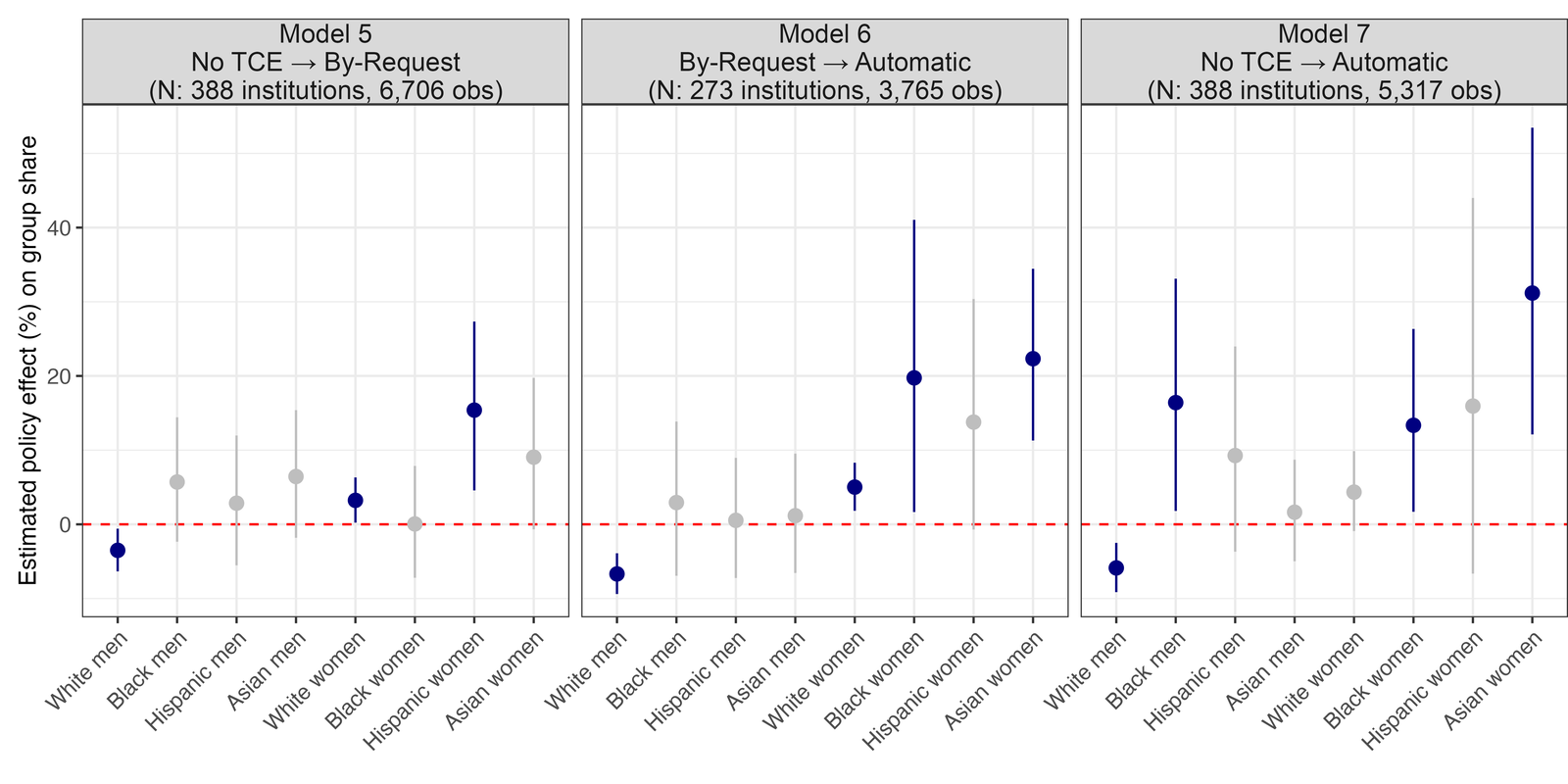
Estimated policy effect on group share for three tenure-clock-extension comparisons: no policy to by-request, by-request to automatic, and no policy to automatic, by demographic group

Gonsalves, Leroy, Kwan Woo Kim, Frank Dobbin, Alexandra Kalev, and Gal Deutsch. “How to Stop the Clock: The Effects of Tenure Clock Extensions on Faculty Diversity.” Revise and Resubmit, American Journal of Sociology.

Finds that tenure-clock extension policies that extend eligibility to all parents, and that automatically enroll parents, are most effective at narrowing gender and racial gaps in tenure representation. Targeted, opt-in programs can instead provoke backlash by marking women as needing special accommodation and by making users visible and vulnerable to stigmatization.

Future Projects

I plan to extend the resource dependence account of “Selective Inclusion” to understand how universities absorb the external shocks now facing the sector — state and federal anti-diversity policies, federal funding cuts, and declines in international enrollment. A missing piece of the resource dependence framework is governance: I posit that a university’s capacity to resist politically motivated financial contraction depends on who holds decision-making authority. Institutions whose boards are appointed by a governor or legislature likely have little buffer against hostile intrusion, while those with faculty representation may retain enough leverage to slow compliance. I plan to collect original data on the composition and appointment structure of university governing boards to test how governance moderates the effect of anti-diversity pressure on faculty hiring outcomes.